DuniaMotif X GMBB Art Residency

Project Overview
When I first entered the residency space at GMBB, I arrived with an intention to explore motifs. I was interested in revisiting Malaysian visual language through silkscreen printing and natural dyes. However, as often happens in my practice, the materials redirected the project.
The residency slowly became less about motif and more about colour.
Not colour in the conventional sense, but colour as a living record of a place. I became interested in the waste generated within GMBB and the surrounding food businesses. Every day, cafés dispose of coffee grounds, avocado skins, tea residue, onion skins, and other organic materials. These materials were often seen as useless once their primary purpose had been fulfilled. Yet I wondered what colours might still remain inside them.
The studio became a space for collecting, boiling, extracting, testing, and observing.
Some days were spent simply waiting. Waiting for a pot of onion skins to release its colour. Waiting to see whether a particular pigment would bind successfully to fabric. Waiting for a print to dry before deciding whether it had failed or succeeded.

I found myself paying attention to materials that most people would overlook.
Coffee grounds from Bad Bad Café produced unexpected earthy tones. Avocado skins collected from Too Yum revealed subtle colour variations depending on their condition and age. Onion skins from Mak Masak continued to surprise me with their richness. Even the residue from a cup of Teh Cham carried traces of colour that could be transformed and preserved.
Each material behaved differently. Some released colour immediately, while others demanded patience. Some colours appeared vibrant at first before fading. Others emerged quietly and deepened over time.
Rather than fighting these inconsistencies, I began treating them as collaborators.
Studio Process & Material Exploration
The residency focused on developing a site-specific pigment system using food waste collected from GMBB tenants and surrounding cafés.
Key processes included:
Collecting and sorting organic waste materials
Extracting pigments through boiling and soaking methods
Testing pigments on different fabrics (i.e.: cotton)
Developing handmade inks for silkscreen printing
Conducting print experiments with the food waste inks
These experiments resulted in a growing archive of colour studies and textile samples.
Material Study: GMBB Colour Archive
A key outcome of the residency was the development of a colour swatch archive derived from GMBB waste materials.
Summary:
Cafes/Eateries involved:
Bad Bad Cafe (Level 2-40 & 41)
Too Yum (Level 1-36)
Jiak Kopi (Level GM-1)
Mak Masak (Level GM-3-40)
Atoz Carbon (Level GM3-3 )
Friends and new network who contributed Avocado pits and skins
Material or waste collected:
Bad Bad cafe (Level 2-40 & 41) | Coffee Grounds
Too Yum (Level 1-36) | Avocado Skins
Jiak Kopi (Level GM-1) | Teh Cham (Jiak Kopi Signature), Wilted
Parsley
Mak Masak (Level GM-3-40) | Onion Skins
Atoz Carbon (Level GM3-3 ) | Biowaste Algae
*Parsley was excluded from the final material selection because of the limited sunlight available in the area which hindered the drying process. Consequently, the material remained excessively moist, resulting in a watery texture and the development of undesirable odours. These conditions rendered the material impractical for application when required.
What could be Improved: Due to the limitations of the space and building facilities, a more structured waste material collection and drop-off system should be established. Currently, café owners deposit waste materials whenever they are available, often leaving them outside the DuniaMotif studio.
As the studio operates only four (4) days per week, some materials remain unattended for several days before collection. This delay can lead to the deterioration of the waste materials, including the development of unpleasant odours, mould growth, and a reduction in their suitability for dye production. Implementing a scheduled drop-off system or providing appropriate temporary storage facilities would help maintain the quality and usability of the collected materials.
Encounters in the Open Studio
One of the most rewarding aspects of the residency was the opportunity to work publicly.
The studio remained open throughout the residency, allowing visitors to witness the process as it unfolded. Many arrived expecting finished artworks but instead encountered pots of boiling plant matter, drying fabric samples, pigment tests, and ongoing experiments.
This often led to conversations.
People shared stories about ingredients they used at home, memories of traditional dyeing practices, or curiosity about how food waste could become colour. Some visitors returned multiple times to see how the project had evolved.
I realised that the project was not only about materials but also about creating opportunities for dialogue.
The studio became a place where questions were as important as outcomes.
A particularly memorable moment occurred during the KL Illustration Fair, held from 1-3 May. I had not anticipated the scale of the crowd passing through GMBB. Suddenly there were far more eyes looking into the studio than I had expected. Curious visitors would pause at the doorway, trying to understand what was happening inside. Unlike the surrounding booths filled with prints, books, and illustrations, my space contained jars of pigment, fabric tests, food waste, and an ongoing process that perhaps required more explanation.
In preparation for the fair, I placed my zine and onion dye kits outside the studio to see whether they would attract interest. They did. People stopped, picked them up, asked questions, and occasionally stepped inside. Not everyone connected with the work immediately. Perhaps the idea of making colour from waste was unfamiliar, or perhaps it did not resonate with their own experiences. I found this just as interesting as the moments of enthusiasm. It reminded me that materials carry different meanings for different people.
One encounter stayed with me long after the fair ended. A woman visiting from Singapore stepped into the studio and began asking questions. What started as a brief conversation developed into nearly an hour of discussion about materials, waste, value, and even human waste. We spoke about the things societies choose to discard and how those discarded materials might still contain knowledge, stories, or potential. It was one of those rare conversations that emerges unexpectedly between strangers and leaves a lasting impression.
By the final day of the fair, I found myself feeling slightly overwhelmed. The constant flow of people, questions, and conversations was energising but also exhausting. At one point, needing a moment away from the studio, I wrote a note and taped it to the door. Instead of writing "Toilet Break," I wrote "Human Break."
Looking back, the note felt strangely appropriate for the residency as a whole. The project was never solely about pigments or textiles. It was about people, attention, curiosity, and the small pauses needed to process everything that happens when a studio becomes a public space.
Reflections
Looking back, the residency revealed that colour can function as a record of place.
The pigments developed during this period were not imported materials or commercially produced products. They emerged directly from the rhythms of GMBB itself, from meals consumed, drinks prepared, and waste discarded.
The residency has strengthened my belief that colour-making can be both a creative practice and a form of environmental reflection. Through simple acts of collecting, extracting, printing, and sharing, waste can become a tool for storytelling, connection, and reimagining our relationship with materials.


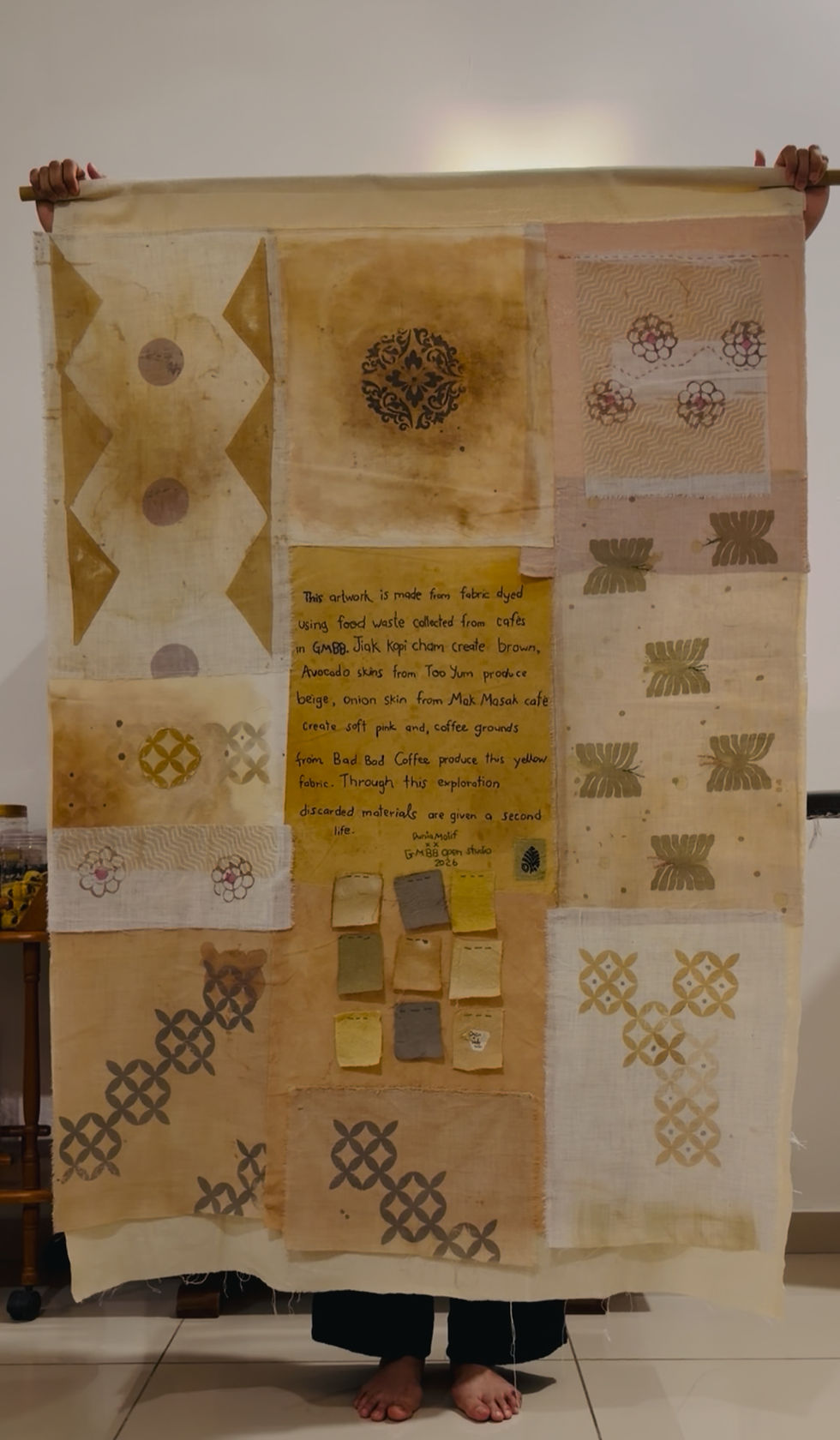
Each colour tells a story of transformation, from discarded kitchen scraps to natural pigments. Through this ongoing exploration, waste materials are given a second life through colour, cloth, and craft.


Comments